Bali Commercial Property 2026: What 1,003 Asking Prices Say About Kos, Ruko and Hotels
15 August 2026 · Bali Villa Hunter
Everyone Writes About Bali Villas. Nobody Writes About Kos-Kosan.
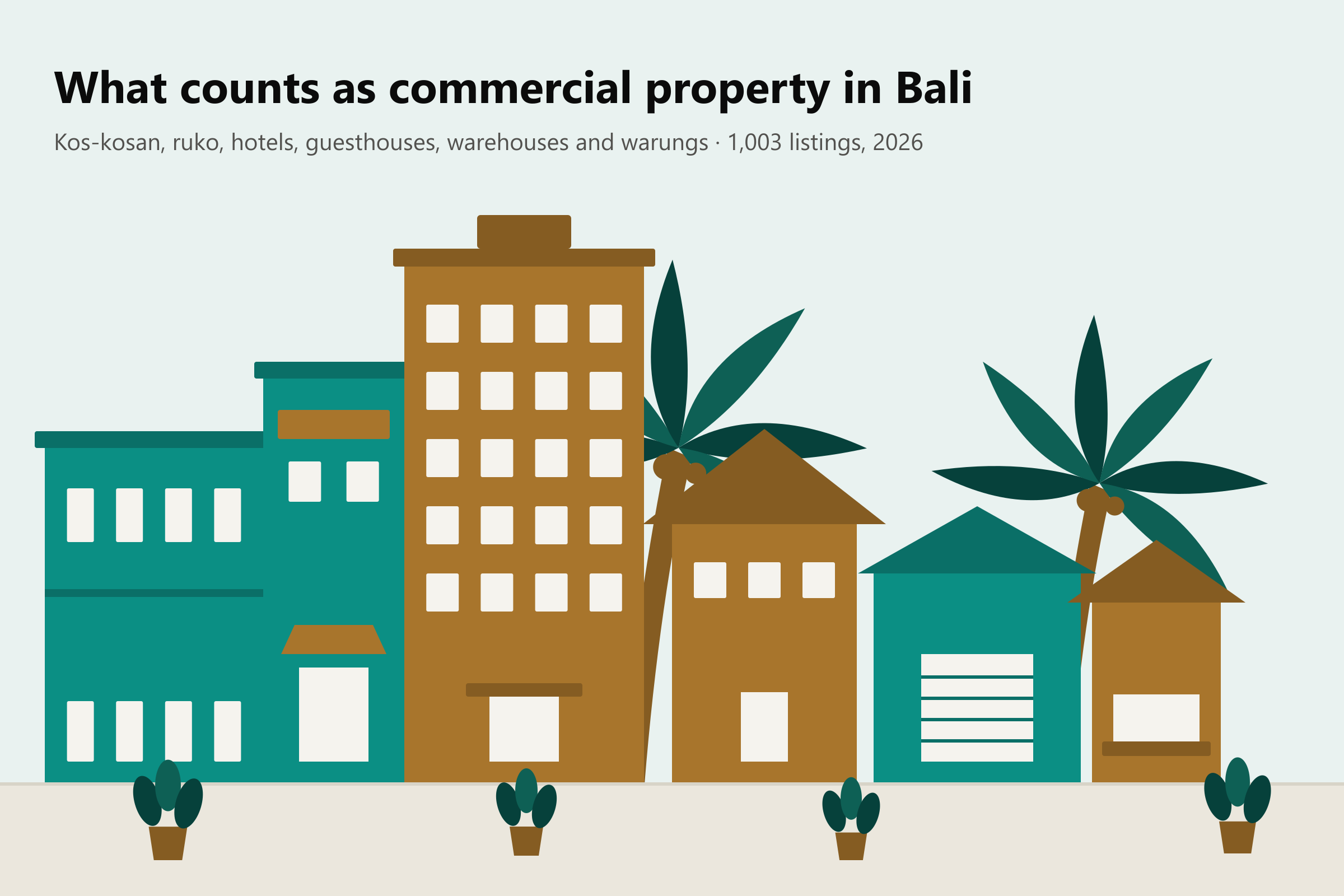
Search for Bali property analysis and you will find villas, land and the occasional hotel deal. Yet when we separated out every commercial building offered for sale across the island over the past five months, the largest single category was none of those. It was kos-kosan — the local boarding house — at 37.5% of all commercial supply.
This is the part of the Bali market that operates in Indonesian, sells to Indonesian buyers, and rarely appears in English. Our other reports deliberately filter it out so it doesn’t distort villa prices or rental yields. This one does the opposite: it is everything we normally throw away.
- 1,003 unique commercial listings across Bali
- 874 with a reliable asking price
- March 20 – August 14, 2026 data range
- 8 property types, from kos to hotel
- 100% real listing data
Bali Commercial Property Prices by Type
Median asking prices for commercial buildings, deduplicated (the same property offered by five agents counts once):
| Type | Listings | Share | p25 | Median ask | p75 | Land | Building | Rooms |
|---|---|---|---|---|---|---|---|---|
| Kos-kosan | 376 | 37.5% | 1.70B | 2.55B | 4.00B | 223m² | 300m² | 10 |
| Ruko / shophouse | 211 | 21.0% | 2.30B | 3.60B | 6.50B | 192m² | 199m² | 3 |
| Hotel / resort | 121 | 12.1% | 16.00B | 32.00B | 65.00B | 1,200m² | 1,500m² | 24 |
| Guesthouse | 97 | 9.7% | 6.00B | 9.00B | 12.00B | 444m² | 600m² | 12 |
| Warehouse / gudang | 92 | 9.2% | 2.53B | 5.50B | 12.50B | 550m² | 512m² | 3 |
| Restaurant / cafe | 35 | 3.5% | 2.05B | 7.00B | 67.00B | 706m² | 382m² | 8 |
| Other commercial | 18 | 1.8% | 7.50B | 22.00B | 24.00B | 1,000m² | 935m² | 8 |
| Office | 12 | 1.2% | — | 9.50B | — | 463m² | 500m² | 14 |
ℹ️ We collect public peer-to-peer commercial listings from Bali’s most active property channels daily, deduplicate them with our own matching system, and drop listings whose stated price cannot be reconciled with the text. These are asking prices, not closed transactions. Six listings above 200B IDR were excluded as evident typing errors. Restaurant, office and “other” samples are small — treat anything under 40 listings as a signal, not a verdict.
Key Market Insights
Kos-Kosan Is The Market — 37.5%. More kos-kosan are offered for sale in Bali than hotels, guesthouses, warehouses and restaurants combined. The median asks 2.55B IDR for 10 rooms.
The Tourist Premium — 2.7x. A kos room asks a median 260M IDR. A guesthouse room asks 708M. The buildings are near-identical in size; the difference is who sleeps in them.
Commercial Land Costs 5% More Than Residential. 1.50B IDR per are against 1.43B. Bali prices location, not permission — and permission is what decides whether your business can legally open.
Two Islands, Not One Market. 67% of kos, 61% of warehouses and 58% of ruko are in Denpasar. Only 6% of hotels and 4% of guesthouses are. These segments barely touch each other.
ℹ️ Per-unit figures calculated from 308 kos and 78 guesthouses that state a room count; land premium from 828 commercial and 5,134 residential freehold listings.
Executive Summary
Bali’s commercial market splits cleanly in two, and the dividing line is not price — it is who the customer is.
The local income market — kos-kosan, ruko, warehouses — sits in and around Denpasar and sells to Indonesian investors. It is the larger half by volume: 679 of our 1,003 listings. Prices are modest and remarkably consistent. A Denpasar kos asks 2.60B, a Denpasar ruko 3.60B, a Denpasar warehouse 5.80B. Rooms and square metres price predictably: 250M per kos room, 18M per square metre of ruko building. This is boring, functional real estate bought for monthly rent from students, workers and small businesses.
The tourist hospitality market — hotels, guesthouses, restaurants — sits along the coast and in Ubud, and is priced in a different currency altogether. A Kuta hotel asks a median 40B, Nusa Dua 42B, Ubud 35B. Guesthouses run 7B in Canggu to 15B in Jimbaran. Denpasar barely participates: 8 hotels and 4 guesthouses in five months.
“A kos and a guesthouse can be the same building with the same eleven rooms. One asks 2.6B, the other 9B. You are not buying bricks — you are buying the right to charge nightly.”
The most useful number in this report is that 2.7x gap, because it is the clearest statement of where value actually sits in Bali commercial property. It is not in the construction. A room costs roughly the same to build in Sesetan as in Seminyak. The premium is location, guest type, and the licence the business operates under — and only the first of those three is visible in a listing.
Kos-Kosan: The Biggest Category Nobody Covers
The typical kos on our list has 10 rooms (a quarter have 7 or fewer, a quarter have 13 or more, the largest 35), sits on 223m² of land with 300m² of building, and asks 2.55B IDR. Per room, the island-wide median is 260M — a quarter sell under 201M, a quarter over 385M.
| Area | Listings | Median ask | Per room |
|---|---|---|---|
| Kuta | 11 | 8.00B | 458M |
| Jimbaran | 18 | 5.62B | 369M |
| Denpasar | 231 | 2.60B | 250M |
| Sanur | 6 | 2.30B | 192M |
| Seminyak | 11 | 1.50B | 208M |
Denpasar is the market — 231 of 308 priced kos with a room count. The outliers are instructive: Kuta and Jimbaran price at 1.5–1.8x Denpasar per room, and Jimbaran’s cluster is largely student housing near Udayana University, a genuinely different tenant base with a genuinely different rent. Sanur and Seminyak look cheap per room, but at 6 and 11 listings those are hints, not conclusions.
Guesthouses: The Same Building, Priced For Tourists
A guesthouse in our data has a median 11 rooms — one more than a kos — on 444m² of land, and asks 9.00B. Per room: 708M, against the kos figure of 260M.
| Area | Listings | Per room |
|---|---|---|
| Seminyak | 10 | 1.33B |
| Canggu | 9 | 1.00B |
| Sanur | 17 | 750M |
| Uluwatu | 8 | 476M |
| Jimbaran | 7 | 413M |
The spread inside the category is as wide as the gap to kos: a Seminyak guesthouse room asks 3.2x a Jimbaran one. Sanur, where our data runs deepest for this type, sits mid-table at 750M.
Put the two tables side by side and the Seminyak comparison is the sharpest in this report: 208M for a kos room, 1.33B for a guesthouse room, in the same area. Both samples are small — 11 and 10 listings — so treat the exact multiple with caution. But the direction is not in doubt, and it is worth understanding why before assuming the gap is an arbitrage opportunity. A building only earns guesthouse economics if it is permitted to run as one.
Ruko, Warehouses and the Rest
Ruko (shophouses) are the volume product of small Indonesian business: 211 listings, median 3.60B, 199m² of building on 192m² of land, 16M IDR per square metre of building (Denpasar 18M, elsewhere 14M). A quarter ask under 2.30B, which makes them the cheapest realistic entry into Bali commercial property — below the median asking price of a villa in Canggu or Sanur.
Warehouses are the surprise of the dataset at 92 listings, 61% in Denpasar, median 5.50B but with a huge spread (p25 2.53B, p75 12.50B) because “gudang” covers everything from a steel-frame shed to a distribution facility.
Hotels ask a median 32.00B, or 1.21B per key across 76 listings that state a room count, on a median of 24 keys. By area: Nusa Dua 42B, Kuta 40B, Ubud 35B, Seminyak 25B, Uluwatu 10B.
Restaurants and cafes we cannot price honestly. Thirty-five listings with a p25 of 2.05B and a p75 of 67B is not a market — it is a label covering a Sanur warung and a Canggu beach club. We include the row for completeness and would not quote it in a negotiation.
Deep Dive into the Numbers
Why is commercial land only 5% more expensive than residential?
Because in Bali, asking prices are set by location and scarcity, not by zoning. The seller of a 5-are plot on a Denpasar main road prices it against neighbouring plots, not against a calculation of the business income it could host. Our commercial listings ask a median 1.50B per are against 1.43B for residential — statistically almost the same land.
For a buyer this is a trap dressed as a bargain. The 5% you didn’t pay is the 5% that would have represented certainty about what you can build and operate. Zoning in Bali is colour-coded on the regional spatial plan: pink and tourism zones permit commercial and accommodation activity, yellow residential zones do not. Two plots with identical asking prices can sit on opposite sides of that line, and nothing in the listing tells you which.
If a kos room is 260M and a guesthouse room is 708M, why not convert one?
People try constantly, and it is the single most common way foreign money gets stuck in Bali commercial property. The conversion is not a renovation problem — the rooms are already rooms. It is a permit problem. Running paid nightly accommodation requires the zone to allow it, a building permit (PBG, formerly IMB) that matches the actual use, and an operating licence for that activity. A kos in a yellow residential zone in Sesetan cannot legally become a guesthouse regardless of how good the beds are.
The secondary obstacle is demand. A kos in Sesetan converted to a guesthouse is still in Sesetan, where tourists are not. The 2.7x premium is roughly half licence and half location, and neither half is transferable by buying paint.
How reliable is the type split itself?
Moderately — and worth stating plainly. Commercial listings do not arrive with a clean type label, so we classify them from the wording of the listing, giving the headline priority over the body text. Clear cases dominate: 96% of kos and 98% of ruko are identified from their own headline.
The soft edges are the small categories. Roughly half our listings mention more than one use — “ruko suitable for a kos or an office” is an ordinary way to advertise in Bali — and a single label has to be chosen. That ambiguity is concentrated exactly where the samples are already thin: restaurant, office and “other”. The four big categories, which carry 80% of the data, are ones we would defend.
Forty-one listings (4.1%) could not be typed at all and are excluded from the type table but included in the totals.
What would rental yields on these look like?
We are not publishing them, because we cannot calculate them honestly. Commercial rents in Bali are advertised through channels that barely overlap with the sale market — a Denpasar kos owner filling rooms does not post the same way an agent selling the building does. Any yield we computed would divide a rent from one segment by a price from another and manufacture a number no real building delivers.
For scale: our residential data shows gross yields of 6.9% to 11.5% depending on area, and those are calculated from matched samples we trust. Treat any commercial yield quoted to you without a stated rent sample as marketing.
Practical Insights
Price per room is the only number that compares buildings. A 2.55B kos and a 9.00B guesthouse are not comparable until you divide by rooms — at which point 260M versus 708M tells you what you are actually paying for. Ask for the room count before the price on any accommodation-type property; if the seller is vague about it, that is itself information.
Verify the zone before anything else, including the price. The asking price contains almost no information about whether your intended business is legal on that plot — that is what the 5% land premium tells us. Zone, building permit (PBG/IMB) matching the real use, and an operating licence for your specific activity are what separate a working business from a very expensive residential building. This is decided at the local office and in the banjar, not in a listing.
Denpasar is a real market with real depth, and it is cheap. 231 kos and 118 ruko listings in five months, at 2.60B and 3.60B medians. If you want income rather than a lifestyle asset, the data says the island’s functioning commercial market is inland, not on the coast where the brochures point.
Discount the thin categories. Office (12 listings), restaurant (35), other (18) — the medians are printed for completeness and should not anchor a negotiation. Kos, ruko, hotel and guesthouse are the four we would argue about with a seller.
These are asking prices. Commercial sellers in Bali negotiate, often more than residential ones, because the buyer pool for a 10-room kos in Sesetan is small and local. The tables above are the starting grid.
Conclusion: The Market Behind the Market
Bali’s property story is told in villas, but a third of everything sold commercially on this island is a boarding house in Denpasar renting rooms to Indonesians by the month. It is the least glamorous and most functional real estate in Bali, it trades at a fraction of coastal prices, and almost nothing is written about it in English.
The numbers give you the map: 260M a kos room, 708M a guesthouse room, 16M a square metre of shophouse, 1.21B a hotel key. What they cannot tell you is the thing that decides whether any of it works — whether that specific building, on that specific plot, is permitted to run the business you intend, and whether the neighbours will live with it.
That part is decided on the ground. Our team in Bali inspects the property, checks the zone and the permits, and negotiates before your money moves. On commercial property that check is not optional — it is the entire deal.